
Brief Outline
-Side mount garage door openers are installed beside the garage door rather than from the ceiling.
-This type of opener might also be called a side mount garage door opener or a jackshaft opener.
-In this case, the motor operates the door using the torsion shaft instead of a ceiling rail system.
-By mounting the opener on the wall, the ceiling is free and can be utilized for other purposes such as storing stuff.
-This is particularly beneficial when there are low beams on the ceiling or when the garage door has low clearance or when there are other obstacles that make it unfavorable for installation of regular garage door opener.
-However, side mount garage door openers are not compatible with all garage doors because of various factors such as type of spring system, shaft configuration and mounting surface.
-Since the installation of the opener involves connection to the torsion system, qualified professional is recommended to evaluate the installation.
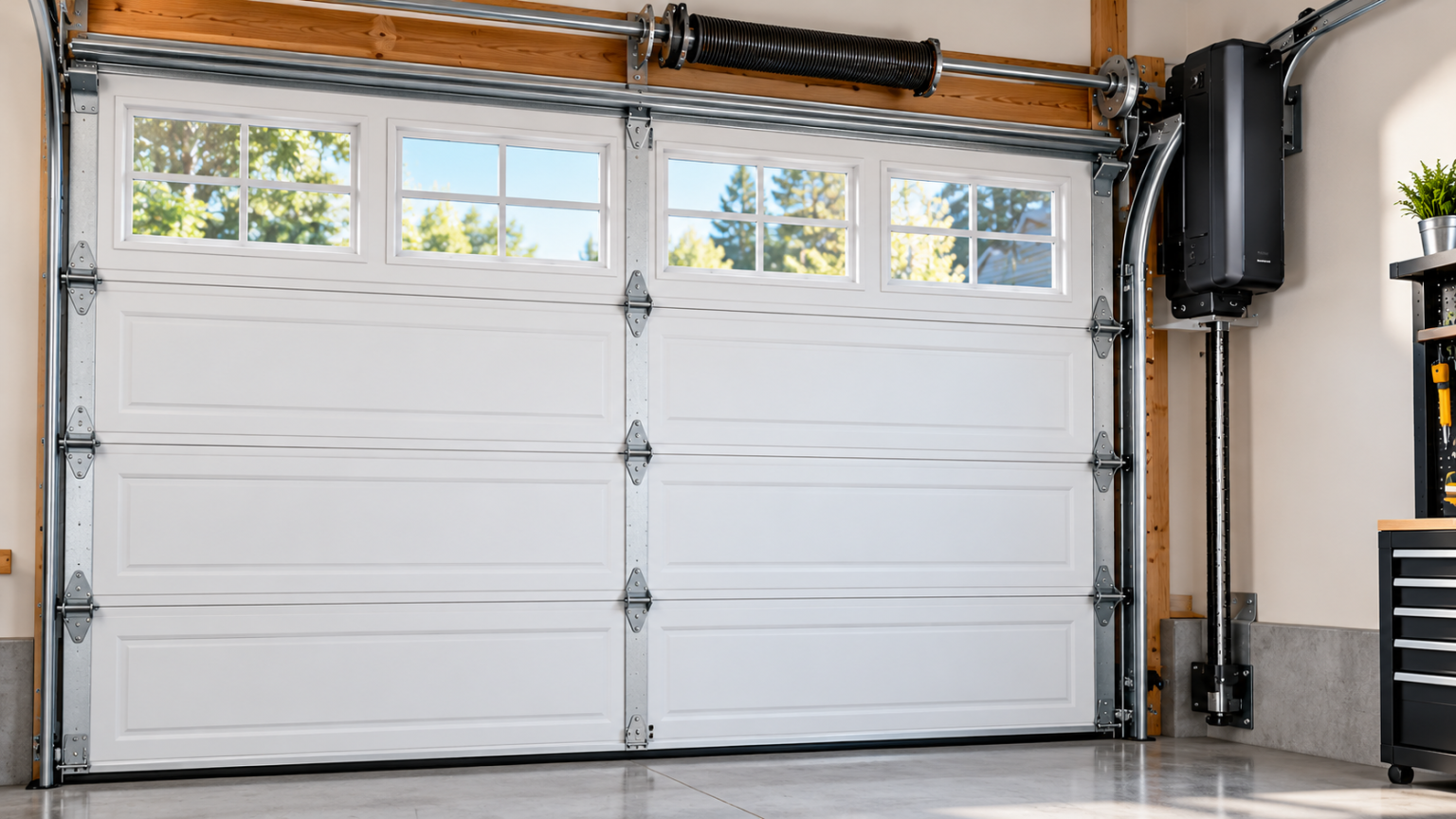
A Side Mount Garage Door Opener can be an excellent alternative to the conventional ceiling-mounted garage door opener. Alongside the fact that the motor and rail are normally located above the center of the door, a side mount model is secured on the wall next to the garage door and uses its torsion shaft to make the door operate.
Such a design can be very useful in garages where the overhead space is limited. The installation of a side mount garage door opener also makes the garage look cleaner because there’s no need to have the long rail and ceiling mounted powerhead found in most conventional systems.
However, wall-mounted openers are not always the best choice for every homeowner. Whether the side-mounted garage door opener is compatible or not depends on the hardware of the garage door, spring configuration, available wall space, and the particular model.
This article will explain the essence of a side mount garage door opener, how it works, and how it differs from a traditional opener, its advantages and disadvantages, and when this type of opener may be a good choice for your garage.
What Is a Side Mount Garage Door Opener?
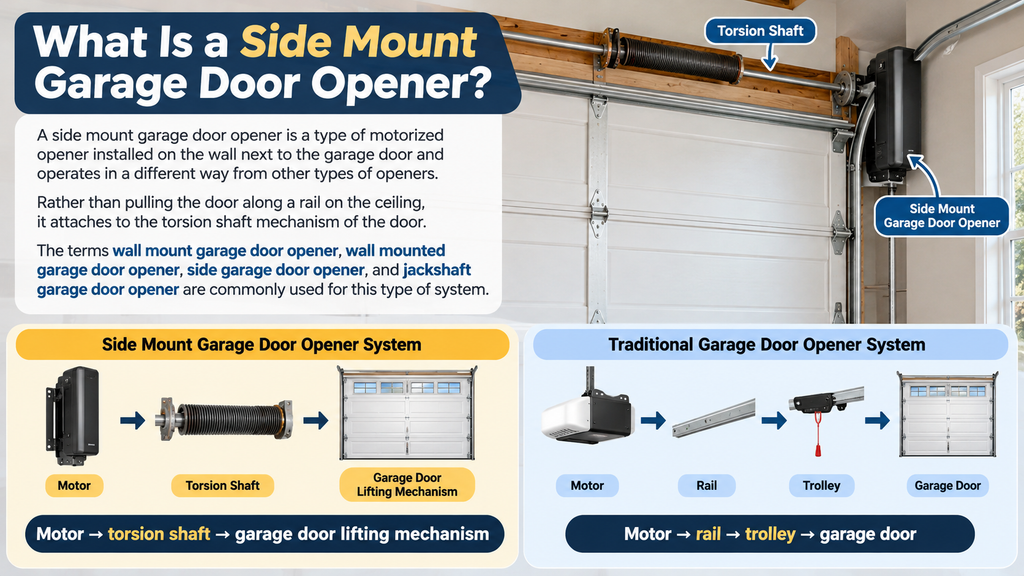
A side mount garage door opener is a type of motorized opener installed on the wall next to the garage door and operates in a different way from other types of openers. Rather than pulling the door along a rail on the ceiling, it attaches to the torsion shaft mechanism of the door.
The terms wall mount garage door opener, wall mounted garage door opener, side garage door opener, and jackshaft garage door opener are commonly used for this type of system.
The basic idea is simple:
Motor → torsion shaft → garage door lifting mechanism
Traditional systems work differently:
Motor → rail → trolley → garage door
How Does a Side Mount Garage Door Opener Function?
1. The motor is placed next to the garage door
The compact motor unit is installed on one side of the garage door, usually close to the end of the torsion shaft.
The mounting bracket has to be installed on a solid, suitable structure.
Depending on the manufacturer’s instructions, the distance between the different components may also need to follow certain requirements, such as the distance between the wall, torsion shaft, ceiling, and other components.
For example, in the installation manual of an older model of LiftMaster 8500, it is said there should be a minimum of 2.5 inches between the garage wall and the center of the torsion bar, in addition to other clearance requirements. Moreover, the recommended measurements may differ by model, therefore, the manufacturer’s instructions should be followed in this case.
2. The opener is connected to the torsion shaft
The opener’s drive mechanism is connected to the torsion shaft using a coupler, collar, or another means of connection, depending on the device’s model. Moreover, when the motor operates, it rotates the shaft.
3. The torsion system opens the door
The torsion shaft is included in the counterbalancing system of the garage door. When this device is moved, the various parts like the drums, cables, and springs work in conjunction to lift the door. This is why compatibility becomes significant in this instance.
A side mount opener is not just a smaller version of the ceiling opener. Such devices is designed around the existing door’s mechanical system.
4. Sensors and Controls control the process
Modern wall-mounted devices are still equipped with safety and control equipments, depending on the model, and these might contain photoelectric safety sensors, wall controls, remote controls, automatic locks, Wi-Fi support, battery backup, and emergency release devices.
According to the U.S. Consumer Product Safety Commission, all automatic residential garage door operators are subject to a mandatory federal safety standard under 16 CFR Part 1211.
What Are the Main Benefits of a Side Mount Garage Door Opener?
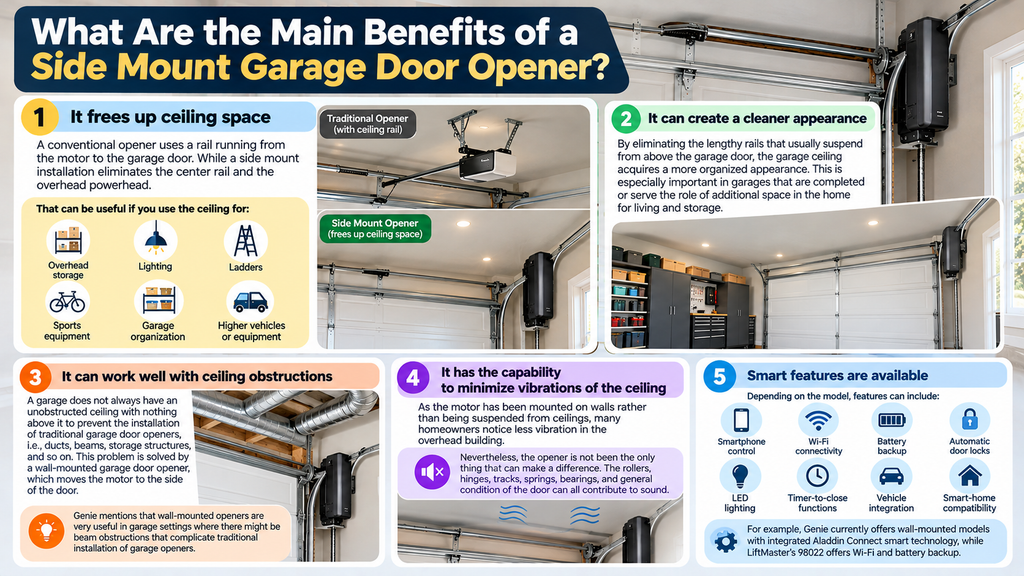
1. It frees up ceiling space
A conventional opener uses a rail running from the motor to the garage door. While a side mount installation, eliminates the center rail and the overhead powerhead.
That can be useful if you use the ceiling for:
-Overhead storage
-Lighting
-Ladders
-Sports equipment
-Garage organization
-Higher vehicles or equipment
2. It can create a cleaner appearance
By eliminating the lengthy rails that usually suspend from above the garage door, the garage ceiling acquires a more organized appearance. This is especially important in garages that are completed or serve the role of additional space in the home for living and storage.
3. It can work well with ceiling obstructions
A garage does not always have an unobstructed ceiling with nothing above it to prevent the installation of traditional garage door openers, i.e., ducts, beams, storage structures, and so on. This problem is solved by a wall-mounted garage door opener, which moves the motor to the side of the door.
The company Genie mentions that wall-mounted openers are very useful in garage settings where there might be beam obstructions that complicate traditional installation of garage openers.
4. It has the capability to minimize vibrations of the ceiling
As the motor has been mounted on walls rather than being suspended from ceilings, many homeowners notice less vibration in the overhead building.
Nevertheless, the opener is not been the only thing that can make a difference. The rollers, hinges, tracks, springs, bearings, and general condition of the door can all contribute to sound.
5. Smart features are available
Depending on the model, features can include:
-Smartphone control
-Wi-Fi connectivity
-Battery backup
-Automatic door locks
-LED lighting
-Timer-to-close functions
-Vehicle integration
-Smart-home compatibility
For example, Genie currently offers wall-mounted models with integrated Aladdin Connect smart technology, while LiftMaster’s 98022 offers Wi-Fi and battery backup.
When to Think About Buying a Wall Mount Garage Door Opener?
You have limited ceiling space
If your ceiling is already packed with equipment, storage, lighting, or beams, moving the opener to the side allows you to make good use of the overhead space.
Your garage has structural obstructions
If a beam blocks the way for a traditional opener’s track, it can pose a problem for installation. A side mounted design provides more options since the motor is positioned beside the door.
You want a cleaner garage ceiling
Removing the overhead rail and motor will create a cleaner look. This is particularly helpful in modern garages with finished ceilings.
You have a high-lift garage door
There are wall-mounted garage door openers made for certain high-lift and vertical-lift configurations. In this instance, different models have different compatibility. A manufacturer may support certain high-lift dimensions while excluding other configurations.
For example for this is that, LiftMaster’s 8500 documentation specified compatibility with certain standard- and high-lift sectional doors and provided specific limits for door dimensions and torsion-bar configuration.
You want battery backup
Power outages can cause a garage door to stop working unless it has a battery backup or some form of manual access.
There are battery backup options for many modern wall-mounted models, such as LiftMaster’s 98022 and Genie’s 6170H-B.
Is a Side Mount Opener Compatible With Every Garage Door?
No. Compatibility should be checked before choosing a side mount opener.
Important factors include:
-Door type
-Spring system
-Torsion shaft diameter
-Shaft extension
-Drum configuration
-Door height and width
-Available side clearance
-Wall construction
-Ceiling clearance
-Electrical access
-Safety sensor placement
-Opener-specific weight and application limits
Side Mount and Traditional Garage Door Opener
| Feature | Side Mount Opener | Traditional Ceiling Opener |
| Motor location | Wall beside door | Ceiling |
| Drive method | Torsion shaft | Rail and trolley |
| Ceiling rail | No | Yes |
| Overhead space | Mostly preserved | Partially occupied |
| Good for ceiling obstructions | Often | Can be challenging |
| Installation compatibility | More specific | Broad, but still model-dependent |
| Smart features | Available on many models | Widely available |
| Battery backup | Available on many models | Available on many models |
| Appearance | Clean, compact | More visible overhead |
What Are the Disadvantages of Using a Side Mount Garage Door Opener?
Installing this type of opener relies heavily on the existing components attached to the garage door
As it directly works with the torsion shaft of the door, those existing components should be up to the standards provided by the manufacturer. Any unsuitable issues with parts like shaft, springs, drums, or door balance would have to be fixed beforehand or additional work done.
It needs sufficient side spacing
The motor should be positioned alongside the garage door, and the area where it is mounted must be strong enough to support the weight.
If there isn’t adequate space the particular type of opener may not be usable.
It might not work with some spring systems
Most residential jackshaft openers need compatible torsion-spring arrangements.
If your garage door doesn’t use that specific type of counterbalancing system, the opener may not be useful unless changes are made to the door.
The installation might involve more specialized work
This situation isn’t just about picking the opener.
When you hire an installer, he or she has to consider or evaluate the door, torsion system, mounting surface, clearances, safety equipment, and opener compatibility together.
What Safety Features Should a Side Mount Opener Have?
Look for a system that includes appropriate:
-Automatic reversing protection
-Photoelectric safety sensors
-Manual emergency release
-Door monitoring features where applicable
-Battery backup when needed
-Manufacturer-approved controls and accessories
UL notes that UL 325 addresses risks linked with powered door operators, such as electric shock, entrapment, fire, and other risks. This standard is referred to by multiple building and fire codes.
CPSC also highlights the value of reversing mechanisms and external entrapment protection for residential garage door operators.
What Are Some Aspects to Review before Selecting a Side Mount Opener?
Garage door compatibility: Ensure that the garage door type and counterbalance system are compatible with the chosen opener.
Torsion shaft: Check if the diameter, length, and configuration of the torsion shaft meet the manufacturer’s specifications.
Space beside the door: Assess the clearance on the side of the door and compare it to the installation manual.
Mounting surface: The opener must be installed on a proper structural surface. Just choosing drywall may not be enough.
Door balance: Before you can rely on the opener, have a professional confirm that the door is balanced.
Safety equipment: Confirm that safety sensors and other required protection can be installed correctly.
Power: Check the availability of the required power source and battery backup if required.
Accessories: If you are looking for mobile app control, auto-lock, LED light, or car integration, make sure that the opener is compatible before buying.
Final Note
The Side Mount Garage Door Opener has opened up a different way of automating the door in your garage. Instead of operating the door from a ceiling-mounted rail, the Side Mount Garage Door Opener operates it from the side by working on the torsion shaft.
The design of the opener has several benefits, including providing you more usable ceiling space, a cleaner look, and increased flexibility for the garages with obstacles overhead.
However, this is not the right solution for every door. You will need to factor in compatibility with torsion systems, available space on the sides, mounting structure, balance of the door, and safety equipment.
So if you are replacing your existing garage door opener or embarking on a new garage door project, make sure that a professional garage door expert assesses the whole set up of the garage door before deciding on going for the wall mounted garage door opener.
Frequently Asked Questions
Is a side mount garage door opener the same as a jackshaft opener?
Yes. In residential garage-door applications, side mount, wall mount, wall mounted, and jackshaft commonly describe the same basic opener concept: a motor mounted beside the door that drives the torsion shaft instead of using a ceiling rail.
Are wall mount garage door openers quieter?
They can be, particularly because there is no ceiling-mounted rail and powerhead transferring vibration through the overhead structure. However, the condition of the door matters too. Worn rollers, hinges, bearings, tracks, or an unbalanced door can still create substantial noise.
Can a side mount opener be installed on either side?
Many models can be installed on either the left or right side, but the usable side depends on the door hardware, shaft configuration, clearances, wall structure, and the manufacturer’s installation requirements. The installation manual should determine which side is suitable.
Does a side mount opener work without a torsion spring?
Many residential jackshaft openers require a compatible torsion-spring system because the motor drives the torsion shaft. Doors using extension springs or other counterbalance arrangements may not be compatible with a particular model.
Does a wall mounted garage door opener save ceiling space?
Yes. The main space-saving advantage is that the motor and rail are moved away from the center of the ceiling. This leaves the overhead area more open for storage, lighting, vehicles, or other uses.
Are side mount openers safe?
Modern residential garage door openers must meet applicable safety requirements and use appropriate entrapment protection. Safety sensors and automatic reversing functions are important. Homeowners should never bypass these systems or operate a door that has a serious mechanical problem.