
The choice of a garage door opener involves more than just picking the model that has the highest horsepower. A 1/2 HP garage door opener, a 3/4 HP one, and a 1 HP one can all be used in a residential setting. However, the choice that you make will depend on the size, weight, and construction of the garage door, the drive system, and its frequency of usage.
Horsepower can also be confusing because modern DC garage door openers are often marketed using an equivalent lifting-force rating rather than traditional motor horsepower. As Chamberlain, for instance, states that DC motor is not measured in HP. So, how can you choose a 1/2 HP, a 3/4 HP, or a 1 HP model?
To get to the answer, we need to understand by reading this article, however, if you are still confused you may still contact an expert to guide you.
Key Takeaways
-The ½ horsepower option works with many standard residential garage doors.
-The ¾ horsepower unit is built for heavier lifting and frequent use.
-Lastly, 1 hp and higher units can be useful for some heavy-duty applications, but it does not mean more horsepower is good.
-The garage door weight, size, balance, and materials are as important as the opener horsepower rating.
-Modern DC openers have been known to use an equivalent HP or lifting power rating that does not mean the ratings should be compared from one brand to another.
-Today, Chamberlain, CRAFTSMAN, and Genie show that, in today’s modern features, battery backup, belt and chain drives, smart controls, and door compatibility may be as important as power rating.
What’s the Meaning of Garage Door Opener Horsepower?
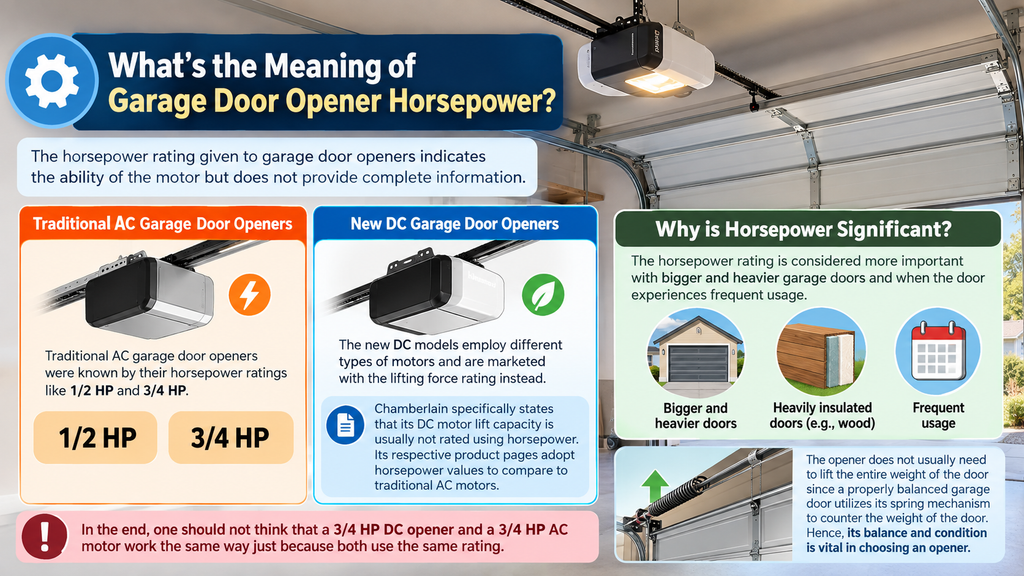
The horsepower rating given to garage door openers indicates the ability of the motor but does not provide complete information.
Traditional AC garage door openers were known by their horsepower ratings like 1/2 HP and 3/4 HP, the new DC models employ different types of motors and are marketed with the lifting force rating instead.
Chamberlain specifically states that its DC motor lift capacity is usually not rated using horsepower. Its respective product pages adopt horsepower values to compare to traditional AC motors.
In the end, one should not think that a 3/4 HP DC opener and a 3/4 HP AC motor work the same way just because both use the same rating.
Why is Horsepower Significant?
The horsepower rating is considered more important with bigger and heavier garage doors and when the door experiences frequent usage. For instance, a typical lightweight residential door does not need the same lifting capacity of a larger door that is made of heavyweight and well-insulated wood.
Nonetheless, the opener does not usually need to lift the entire weight of the door since a properly balanced garage door utilizes its spring mechanism to counter the weight of the door. Hence, its balance and condition is vital in choosing an opener.
1/2 Horsepower Garage Door Opener: What Is It Good For?
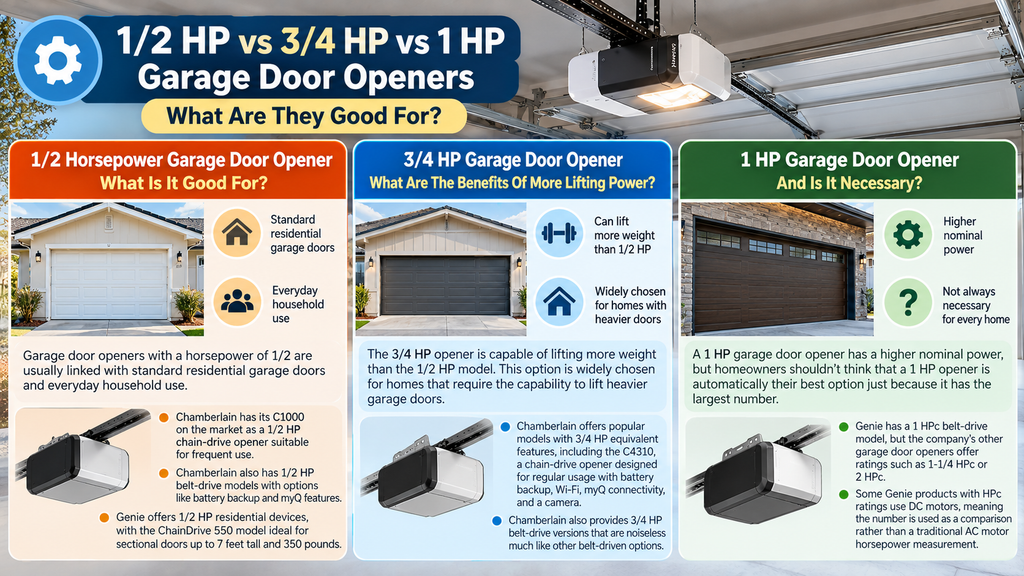
Garage door openers with a horsepower of 1/2 are usually linked with standard residential garage doors and everyday household use.
For instance, Chamberlain has its C1000 on the market as a 1/2 HP chain-drive opener suitable for frequent use. The company also has 1/2 HP belt-drive models equipped with options like battery backup and myQ features.
Genie offers 1/2 HP residential devices, too. The ChainDrive 550 model is said to be ideal for sectional doors that are 7 feet tall and have a weight of up to 350 pounds.
3/4 HP Garage Door Opener: What Are The Benefits Of More Lifting Power?
The 3/4 HP opener is capable of lifting more weight than the 1/2 HP model. This option is widely chosen for homes that require the capability to lift heavier garage doors.
Chamberlain is currently offering some popular models with 3/4 HP equivalent features, including C4310, which is a chain-drive opener that is designed for regular usage and includes battery backup, Wi-Fi and myQ connectivity, as well as a camera.
Chamberlain also provides 3/4 HP belt-drive versions that are noiseless much like other belt-driven options.
What Can Be Said About 3/4 HP Genie Opener?
The SilentMax 750 from Genie has a 3/4 HPc belt drive system. The manufacturer claims that the opener is capable of carrying sectional garage doors as much as 500 pounds with a height of 7 feet.
Another model is ChainDrive 750 which has a 3/4 HPc DC motor installed for working with sectional doors of up to 7 feet height and weighing up to 500 pounds.
1 HP Garage Door Opener: And Is It Necessary?
A 1 HP garage door opener has a higher nominal power, but homeowners shouldn’t think that a 1 HP door opener is automatically their best option just because it has the largest number.
Current home products show why HP ratings have become even more complicated over time.
For instance, the Genie has a 1 HPc belt-drive model, but the company’s other garage door openers offer ratings such as 1-1/4 HPc or 2 HPc.
At the same time, some Genie products that use HPc ratings have DC motors, meaning the number is being used as a comparison rather than a traditional AC motor horsepower measurement. Genie itself explains in its product information that its newer models can use HPc terminology.
When Might a Higher-Rated Opener Be Considered?
It is only considered if the garage door is:
-Larger than a typical single-car residential door
-Heavier because of its construction
-Heavily insulated
-Frequently operated throughout the day
-Specifically listed by the manufacturer as requiring greater lifting capacity
1/2 HP vs 3/4 HP vs 1 HP: What’s the Difference?
| Factor | 1/2 HP | 3/4 HP | 1 HP |
| Typical residential use | Standard | Standard to demanding | Higher-demand applications |
| Lifting capacity | Lower | Higher | Higher still |
| Lightweight doors | Suitable | Suitable | Usually unnecessary |
| Heavier doors | Depends on specifications | Often more appropriate | May be appropriate |
| Frequent operation | Model-dependent | Often a good fit | Model-dependent |
| Noise level | Depends on drive system | Depends on drive system | Depends on drive system |
| Smart features | Available | Widely available | Model-dependent |
| Battery backup | Model-dependent | Widely available | Model-dependent |
| Best comparison method | Door + manufacturer specs | Door + manufacturer specs | Door + manufacturer specs |
Should You Choose Horsepower or Door Weight First?
Before buying an opener, identify:
-Door type
-Door width and height
-Approximate door weight
-Door material
-Insulation
-Opening frequency
-Drive type
-Required features
-Battery-backup requirements
-Manufacturer compatibility requirements
What is the Importance of Door Balance?
A garage door that has a working counterbalance system is meant to operate easily and with minimal pressure on the opener.
When a garage door becomes hard to open, shudders, stops unexpectedly, or seems heavier than usual, raising the horsepower of its opener is unlikely to address the issue.
The problem may be due to the door’s springs, rollers, tracks, cables, or other equipment.
These parts may need to be examined by a qualified garage door technician because some parts contain high amounts of stored tension.
How are the Ratings of Chamberlain, CRAFTSMAN, and Genie Compared?
Chamberlain Garage Door Opener with 1/2 Horsepower
-Chamberlain now offers models with 1/2 HP that operate using chain and belt drives.
-The 1/2 HP DC chain drive model C1000 comes with the myQ connectivity feature as well as soft start and stop features.
-The company offers 1/2 HP belt-drive models that come with battery backup power as well as smart home compatibility.
CRAFTSMAN 1/2 Horsepower Garage Door Opener
-CRAFTSMAN CMXC1220 is a 1/2 HP smart chain-drive opener.
-This model includes built-in Wi-Fi, myQ Smartphone control, safety reversing sensors, a couple of remotes, and a two-light mechanism.
-CRAFTSMAN also mentions its 3/4 Horsepower smart belt drive model CMXB4230 which is equipped with a battery backup and can be controlled by a Smartphone.
The Genie 1/2 HP Garage Door Opener
-Genie has a range of 1/2 horsepower types for residential sectional doors.
-Taking ChainDrive 550 as an example, its specifications show it can handle sectional doors reaching 7 feet in height and weighing 350 pounds.
-The 3/4 horsepower version referred to as ChainDrive 750 also accommodates the same height of 7 feet but has a heavier door limit of up to 500 pounds, demonstrating how published door capacity can vary between models.
Does a Bigger Horsepower Rating Mean a Better Garage Door Opener?
Not necessarily. While high horsepower rating may indicate a strong lifting capability, it does not mean that the opener is quieter, safer, more intelligent or suited for your garage.
Drive Type
Models with chain drive are known for their durable operation, whereas, belt drive models are chosen for their noiseless working capability.
For instance, Chamberlain affirms its 3/4 HP versions with belt drive as the most silent option for attached garages.
Battery Backup
Battery backup ensures that the door opener continues working when there is a blackout.
This is particularly important in the state of California. Some Chamberlain and Genie products now come equipped with a battery backup option.
Smart Connectivity
Contemporary openers may include smartphone control, notifications on activity, programmed actions, cameras, and integration with smart-home systems. Moreover, these characteristics do not rely only on horsepower.
Gentle Starting & Stopping
Some modern openers gradually start and stop the door rather than abruptly changing movement. Chamberlain has soft start/stop on several of its new DC models.
Which Horsepower Should You Choose?
A 1/2 HP Opener May Fit When:
-You have a standard residential sectional door.
-The door is relatively lightweight.
-The manufacturer specifically approves the opener for your door.
-Household use is relatively normal.
-You want a straightforward residential opener.
A 3/4 HP Opener May Fit When:
-The door is heavier.
-The opener will receive frequent use.
-You want additional lifting capacity.
-Your chosen model is specifically rated for the door.
-You want features such as battery backup or quieter belt-drive operation.
A 1 HP Opener May Fit When:
-The manufacturer specifies the higher-capacity model for your application.
-The door is larger or heavier.
-The opener is designed for your particular door configuration.
-You have a specific need for the additional capacity.
Conclusion
When choosing between a garage door opener with 1/2 horsepower, 3/4 HP, and 1 HP, consider the garage door, not simply the horsepower figure. A 1/2 HP garage door opener should do just fine for most residential garage doors. A 3/4 HP opener has extra power, making it better suited to heavy doors or doors that are opened frequently. Finally, a 1 HP opener is useful for situations where the garage door being opened is heavy, provided the opener is rated for that door.
Most importantly, remember that modern DC opener ratings are not always directly comparable to traditional AC horsepower. Manufacturers such as Chamberlain explicitly note that DC motor lift capacity is typically not measured in horsepower.
When uncertain, the best you can do is compare the specific garage door to its size and weight, the materials it is made of, and its specifications before selecting an opener.
For installation or a professional assessment, Optimal Garage Doors notes that its installation process includes opener installation, safety-sensor adjustment, and final system testing.
FAQ
Is a 1/2 horsepower garage door opener enough?
A 1/2 horsepower garage door opener can be sufficient for many standard residential garage doors when the opener is properly matched to the door. Always check the manufacturer’s specifications for door size, weight, height, and construction before choosing a model.
Is 3/4 HP better than 1/2 HP for a garage door opener?
A 3/4 HP-rated opener provides greater lifting capacity, but that does not automatically make it the better choice for every home. The correct rating depends on the door and the opener’s published specifications.
Do I need a 1 HP garage door opener?
Not necessarily. A 1 HP or higher-rated opener may be useful for certain heavier or demanding applications, but a properly matched 1/2 or 3/4 HP model can be sufficient for many residential doors.
Is a 1/2 horsepower garage door opener good for a two-car garage?
It depends on the door rather than simply the number of cars. A two-car garage commonly has a wider door, so homeowners should check the opener’s approved door width, height, weight, and construction before choosing a 1/2 HP model.
Are 1/2 HP garage door openers still available?
Yes. Current products from Chamberlain, CRAFTSMAN, and Genie include 1/2 HP or 1/2 HPc residential models. The exact specifications and features vary by model.
Does horsepower determine how quiet a garage door opener is?
No. Noise is strongly affected by the opener’s drive system and motor design. Belt-drive openers are commonly marketed for quieter operation, while chain-drive models can prioritize durable operation.