
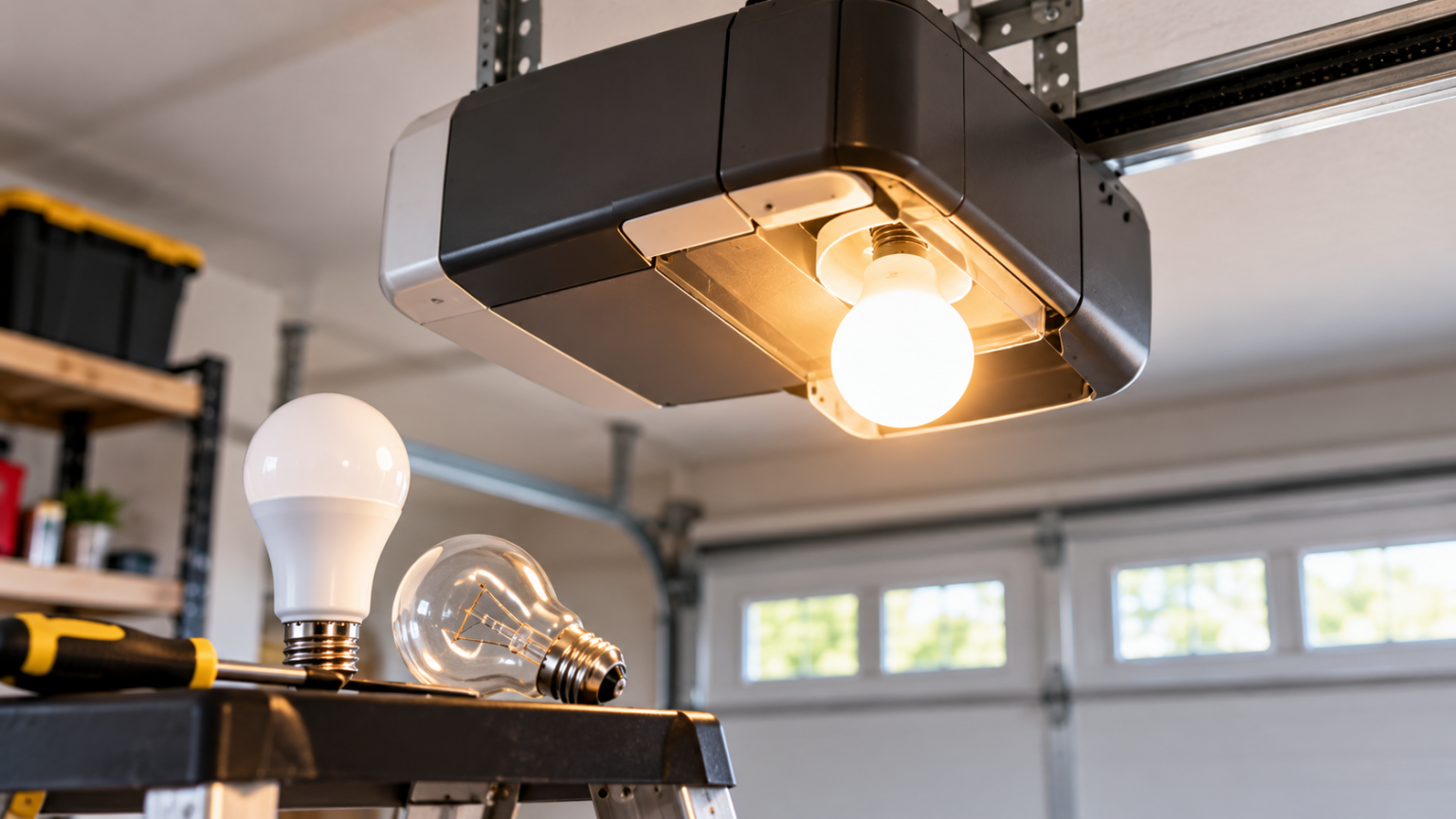
The light bulb for the garage door opener should not require frequent replacement. If you find that a bulb is burning out every couple of weeks or months, something else could be wrong. Frequent burnouts could be caused by vibrations, excessive temperatures, an incompatible bulb, electrical issues, or a socket that is not making good contact. On certain door openers, an unsuitable LED bulb might also affect the performance of the remote control.
However, finding out the cause of the problem is not too difficult. Your goal is to use the right bulb for your opener. This might be the reason why many people try to replace their common bulbs that could fit into the socket instead of using the right bulb for the garage opener. Moreover, contact a professional garage door expert to guide you.
Brief Overview
-Over-vibration from the opener could reduce bulb longevity.
-Heat accumulation may harm bulbs and sockets.
-Using the wrong bulb type or wattage can possibly go beyond opener’s specifications.
-It’s possible that the LED bulbs cause radio-frequency interruptions in some garage openers.
-Improper or broken socket may result in flicker and early failure.
-Electrical issues should be solved by a professional.
-Old opener may be experiencing problems with lighting components and other electrical parts.
Why Do Garage Door Opener Light Bulbs Burn Out So Frequently?
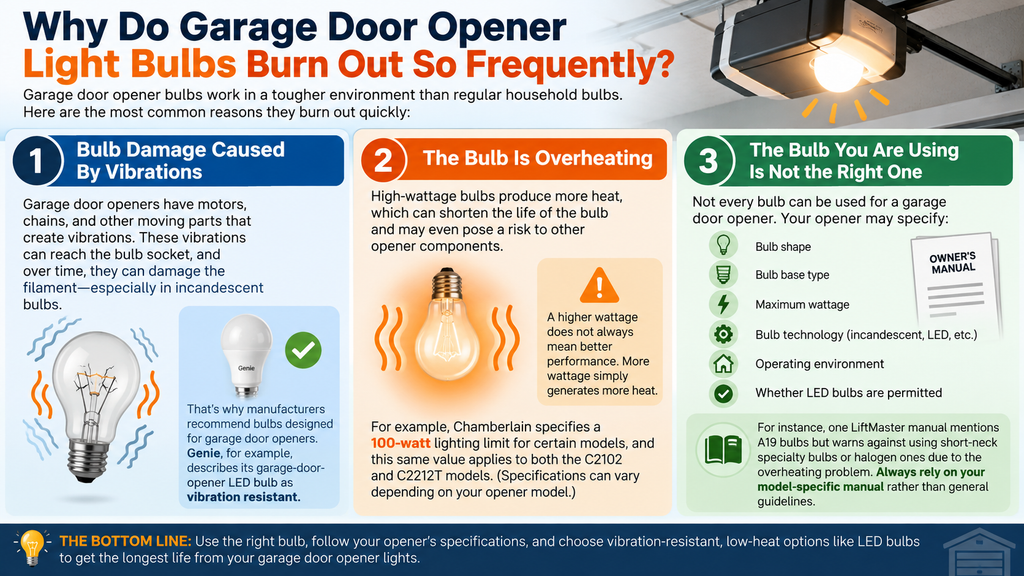
Garage door openers place more stress on light bulbs than regular lamps at home.
When the opener works, its moving parts and motor generate vibration. It may also happen to be inductor or somewhat enclosed in some opener housings, thus contributing to some heat build-up.
The light cycle is also required to be taken into account. Certain openers turn their light on when the opener works and turn it off again after a certain time period. For instance, one LiftMaster manual states that the opener’s lights switch off automatically after 4.5 minutes.
This continuous switching coupled with vibration and heat, can lead to a bulb combustion earlier than expected.
1. Bulb Damage Caused By Vibrations
Vibration is one of the reasons for the early failure of bulbs.
Garage door opener consists of various parts like motors, chains, and other moving parts. These items vibrate and form vibrations that can reach the housing and the bulb socket.
Incandescent light bulbs are especially sensitive to vibrations as their filaments get damaged with passing time.
Thus, electrical bulb manufacturers recommend using bulbs designed explicitly for garage door openers. Genie, for example, describes its garage-door-opener LED bulb as vibration resistant.
2. The Bulb Is Overheating
Heat is another common reason for bulb problems.
If you are using a high-wattage bulb, it may produce more heat, which can shorten the life of the bulb and also pose a danger to other components.
You should never assume that a bulb which has higher wattage is automatically better, as it will produce more light.
It is now possible to see the specifications for a Chamberlain model which needs 100 watts of lighting. But to be more precise, there are variations depending on the model of the opener. For example, Chamberlain recommended the same value (100 watts lighting limits) for both C2102 and C2212T models.
3. The Bulb You Are Using Is Not the Right One
Not every bulb can be used for a garage door opener.
Your opener may specify the following:
-Bulb shape
-Bulb base type
-Maximum wattage
-Bulb technology
-Operating environment
-Whether LED bulbs are permitted
For example, one of the LiftMaster remote-light installation manuals mentions A19 bulbs but warns against using short-neck specialty bulbs or halogen ones due to the overheating problem.
Hence, it is better to rely on model-specific manual than on general guidelines regarding garage door opener bulbs.
Could an LED Garage Door Opener Light Bulb Create Problems?
Absolutely. An LED garage door opener light bulb can be a great choice, but you must ensure compatibility.
LED bulbs of today are made with electronic parts that generate radio-frequency emissions. Sometimes, those emissions can interfere with garage door remote signals.
Chamberlain recommends checking CFLs and LED bulbs during diagnosis of range issues from a remote because of their capacity to emit radio signals.
In a similar light, Genie warns that some LED bulbs may diminish a transmitter’s range and designed an LED bulb for garage door openers to reduce this kind of issue.
What Do You Do If Your LED Bulb Is Working Fine but the Remote Doesn’t Work Properly?
Suppose you have fitted a bulb in your garage door opener and the remote works only when you are really close. This may be because the bulb is interfering.
One easy way of assessing the situation is disconnecting the bulb and check the remote again. Chamberlain says to conduct this kind of test if interference from LED or CFL light has been suspected.
If the remote works properly after removing the bulb, replace the bulb that is specifically designed for a specific garage door opener or that is only suggested by the manufacturer.
Which Garage Door Opener Bulb Is the Right Choice?
LED bulbs for garage door openers
LED technology comes with a number of benefits such as low energy consumption, long life expectancy, and greater durability.
Nevertheless, not every LED light bulb for households will work for your garage door opener. You have to find a bulb that was created exactly for garage doors or that is certified by its manufacturer to be used with the device.
LiftMaster manufactures LMLED1 which has been specially advertised as a LED bulb for garage openers. It provides 800 lumens brightness equivalent to that of a 60-watt incandescent bulb. It was also developed to minimize radio-frequency interference.
Another reliable LED for garage door openers comes from Genie. The company claims that their product has a lifespan of 25,000 hours under standard operating conditions.
Incandescent Bulbs
Some older garage door openers can use incandescent bulbs.
For example, they can use standard A19 incandescent light bulbs, which maximum wattage is 60 in most Genie opener models, but Genie recommends checking the owner’s manual for the suitable wattage figures.
Older LiftMaster apparatus may have different specifications. For instance, in the LiftMaster instruction manual for older garage door openers, A19 incandescent light bulbs for 100 watts may be specified.
What is the Solution for Preventing Garage Door Opener Bulb from Burning?
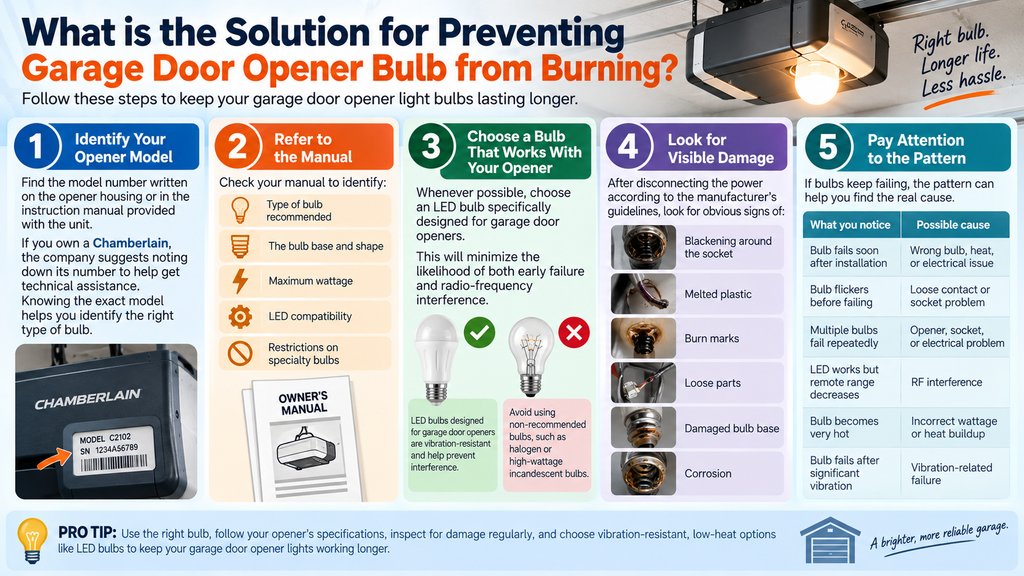
Step 1. Identify Your Opener Model
Find the number of the model written on the opener housing or in the instruction manual provided with the unit.
If you own a Chamberlain, then the company suggests noting down its number to help get technical assistance.
The knowledge of the exact model helps one identify the right type of bulb.
Step 2. Refer to the Manual
Identify:
-Type of bulb recommended
-The bulb base and shape
-Maximum wattage
-LED compatibility
-Restrictions on specialty bulbs
Step 3. Choose a Bulb That Works With Your Opener
When seeking an LED bulb, whenever possible, choose one that has been specifically designed for garage door openers.
This will minimize the likelihood of both early failure and radio-frequency interference.
Step 4. Look for Visible Damage
After disconnecting the power according to the manufacturer’s guidelines, look for obvious signs of:
-Blackening around the socket
-Melted plastic
-Burn marks
-Loose parts
-Damaged bulb base
-Corrosion
Step 5. Pay Attention to the Pattern
| What you notice | Possible cause |
| Bulb fails soon after installation | Wrong bulb, heat, or electrical issue |
| Bulb flickers before failing | Loose contact or socket problem |
| Multiple bulbs fail repeatedly | Opener, socket, or electrical problem |
| LED works but remote range decreases | RF interference |
| Bulb becomes very hot | Incorrect wattage or heat buildup |
| Bulb fails after significant vibration | Vibration-related failure |
Can the light socket cause the problem?
Yes. The problem of burnt out bulbs can arise due to a socket that is worn out or damaged.
In case of a bad socket making an unreliable connection, the bulb will start flickering or will work intermittently. Another indication of a problematic socket is the appearance of heat or an unusual color around it.
One should also consider a socket problem when multiple bulbs burn out. If one had to replace burnt bulbs several times, it may happen again because new bulbs cannot change anything.
When Should You Stop Replacing the Bulb and Call a Professional?
It is time to contact a professional if you encounter situations that indicate that your garage door opener is experiencing electrical problems even if you have been using quality bulbs.
Professional inspection is appropriate if you observed the following signs:
-Burning odors
-Awful smelling or even melted plastics
-Sparks
-Flickering of lights repeatedly
-An apparent socket damage
-Electrical humming sound associated with the light
-Bulbs burning out quickly
-Other irregularities experienced when using the opener
Never open any electrical devices or try to fix internal electrical problems unless you are trained to do so.
Openers of garage doors can create safety hazards. According to UL Solutions referring to the UL 325, the safety hazards include electric shocks, fires, injuries, or entrapment, and therefore the importance of installing, using, and maintaining the opener safely.
In the US, the federal law states that while using automatic garage door openers at home, the residential user of these openers should abide by the laws provided in CPSC Regulation 16 CFR part 1211.
The safest approach is to leave electrical or mechanical problems to a qualified garage door technician or electrician, depending on the issue.
Conclusion
If a garage door opener light bulb goes out too frequently, this can be a sign that something might be wrong. The reason behind this could be a wrong choice of bulb or something more serious like too high heat or malfunctioning socket.
To fix the issue, first of all, you should determine which brand and model of opener you have and verify what the manufacturer recommends. If the bulb is to be replaced with LED, then it must fit into the garage door opener and be able to absorb shocks and minimizes radio frequency interferences.
Most importantly, do not keep changing bulbs even if they burn out, because recurrent problems such as a burning smell or flickering signal that you need professional help.
A proper light bulb can solve the issue, but if that fails, the bulb is probably not the cause of the problem.
Frequently Asked Questions
Why does my garage door opener light bulb keep burning out?
A garage door opener light bulb may burn out repeatedly because of vibration, excessive heat, incorrect wattage, an incompatible bulb, a damaged socket, or an electrical problem. If properly rated replacement bulbs continue failing, have the opener and socket inspected rather than repeatedly replacing bulbs.
Can I use an LED bulb in my garage door opener?
Often, yes, but not every LED bulb is appropriate. Some LEDs can produce radio-frequency interference that reduces garage door remote range. Check your opener manual and choose an LED specifically designed for garage door opener applications when possible.
What wattage bulb should I use in a garage door opener?
There is no universal wattage for every opener. Requirements vary by model. Some current Chamberlain models specify 100 watts, while Genie models may specify different maximums. Always follow the exact wattage listed in your opener’s manual.
Why does my LED bulb affect my garage door remote?
Some LED and CFL bulbs can generate radio-frequency emissions that interfere with garage door opener signals. If remote range becomes poor immediately after installing an LED bulb, remove the bulb temporarily and test the remote. If performance improves, use a compatible opener-rated bulb.
How long should a garage door opener light bulb last?
Lifespan depends on bulb type, operating conditions, vibration, heat, and usage. Opener-specific LEDs can last considerably longer than traditional incandescent bulbs. For example, Genie states that its opener LED bulb has been tested to last 25,000 hours under normal operating conditions.
Should I use a regular household LED bulb?
Not necessarily. A household LED may fit the socket but still be unsuitable because of radio interference, heat, vibration, or manufacturer restrictions. An opener-rated LED is generally a better choice when the manufacturer permits LED use.